LEOPARD IMAGING LI-IMX-334-MIPI-M12 Camera Module Mipi
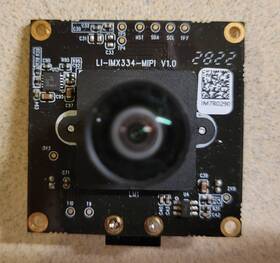
( Brand: Leopard Imaging ), ( Manufacturer Part Number: LI-IMX-334-MIPI-M12 ), ( Type: Camera Sensor ), ( Items Included: Camera ), ( Color: Black ), ( Connectivity: Mipi Csi )
Review LEOPARD IMAGING Imx334 Mipi M12 Camera Module
The **Leopard Imaging LI-IMX334-MIPI-M12** is a high-performance, compact camera module designed for applications requiring exceptional image quality, low-light sensitivity, and robust connectivity. Built around the **Sony IMX334** sensor a 1/2.8-inch, back-illuminated (BSI) CMOS imaging array this module delivers outstanding resolution and dynamic range, making it ideal for industrial inspection, machine vision, automotive ADAS (Advanced Driver Assistance Systems), and security surveillance. The IMX334 boasts a **12.3-megapixel** resolution with a **pixel size of 2.4 m**, ensuring crisp, detailed visuals even in challenging lighting conditions. Its **global shutter** functionality eliminates motion blur in high-speed applications, while the **12-bit digital output** via MIPI CSI-2 interface ensures high-fidelity data transfer with minimal latency, supporting frame rates up to **60 fps** at full resolution.
The **M12 connector** provides a durable, standardized interface for easy integration into OEM systems, offering robust mechanical and electrical protection against environmental factors like dust, moisture, and vibration. This module supports **parallel and MIPI CSI-2** data transfer modes, catering to both legacy and modern processing architectures, including FPGAs, SoCs, and embedded vision platforms. With an **active pixel array of 4032 3024**, the LI-IMX334-MIPI-M12 excels in applications demanding high precision, such as barcode scanning, defect detection, and facial recognition, while its **low noise performance** and **high quantum efficiency** enhance performance in low-light scenarios. Additionally, the module s **compact form factor** and **low power consumption** make it suitable for resource-constrained edge devices, where efficiency and reliability are paramount.
Leopard Imaging s rigorous quality control ensures consistent performance, with features like **auto-exposure control (AEC), auto-white balance (AWB), and digital gain adjustment** simplifying integration for developers. The module s **wide dynamic range (WDR)** capability further enhances its versatility, allowing it to capture both bright and dark areas in a single frame without overexposure or loss of detail. Whether deployed in **autonomous vehicles for obstacle detection, medical imaging for high-resolution diagnostics, or smart manufacturing for quality assurance**, the LI-IMX334-MIPI-M12 delivers a seamless blend of technical excellence and practicality, making it a standout choice for next-generation vision applications.
The **Leopard Imaging LI-IMX334-MIPI-M12** is a camera module based on the Sony IMX334 sensor, a popular choice for high-resolution machine vision and industrial applications. Below is a detailed breakdown of its pros and cons, followed by a conclusion and recommendation.
---
### **Pros of the LI-IMX334-MIPI-M12 Camera Module**
1. **High Resolution and Image Quality**
The IMX334 sensor offers a **12.3-megapixel (4056 3040) global shutter** CMOS sensor, delivering sharp, high-detail images with excellent low-light performance. The global shutter minimizes rolling shutter distortion, making it ideal for applications requiring precise timing (e.g., industrial inspection, robotics, and automation).
2. **Global Shutter Capability**
Unlike rolling shutter sensors, the IMX334 provides a **true global shutter**, which is crucial for applications where objects move rapidly or where exposure must be synchronized across the entire frame (e.g., barcode scanning, high-speed sorting, or 3D profiling).
3. **Low Light Performance**
The sensor includes **back-illuminated (BSI) technology**, which improves light sensitivity and reduces noise in low-light conditions. This makes it suitable for applications in dimly lit environments or where additional lighting is impractical.
4. **MIPI Interface**
The module uses a **MIPI CSI-2 interface**, which is efficient for high-speed data transfer and reduces cable clutter. This is particularly advantageous in compact or high-density systems where space and signal integrity are concerns.
5. **M12 Mount Compatibility**
The M12 mounting standard ensures a robust, standardized connection for lens attachment, making it easier to integrate with existing systems. The M12 mount also supports a wide range of lenses, providing flexibility in optical configuration.
6. **Compact and Modular Design**
The module is designed for **industrial and embedded applications**, offering a compact form factor that can be integrated into tight spaces. Leopard Imaging s modules are often pre-configured with necessary electronics (e.g., power regulation, MIPI conversion), simplifying integration.
7. **Support for High Frame Rates**
Depending on the system s processing capabilities, the IMX334 can achieve **high frame rates** (though exact rates depend on resolution, pixel binning, and system constraints). This is useful for dynamic applications like motion tracking or real-time monitoring.
8. **Leopard Imaging s Reputation**
Leopard Imaging is a well-established manufacturer of industrial camera modules, known for reliability, technical support, and compatibility with major development platforms (e.g., Linux, Windows, and embedded systems). Their modules often include software tools for easier integration.
9. **Wide Dynamic Range**
The IMX334 supports **high dynamic range (HDR) modes**, allowing for better contrast in scenes with mixed lighting conditions (e.g., bright highlights and dark shadows).
10. **Compatibility with Common Development Tools**
The module is often supported by frameworks like **OpenCV, HALCON, and MATLAB**, making it easier to develop and deploy vision applications without extensive custom hardware development.
---
### **Cons of the LI-IMX334-MIPI-M12 Camera Module**
1. **Cost**
High-resolution global shutter sensors like the IMX334 are **more expensive** than lower-resolution or rolling shutter alternatives. The cost may be prohibitive for budget-sensitive applications where lower resolution suffices.
2. **Power Consumption**
The IMX334, like many high-performance sensors, requires **higher power draw** compared to simpler sensors. This may necessitate additional power management in the system, potentially adding complexity or cost.
3. **Heat Dissipation Requirements**
High-resolution sensors can generate **heat**, especially when operating at high frame rates or in continuous use. Adequate thermal management (e.g., heat sinks, cooling) may be required to maintain performance and longevity.
4. **Limited Onboard Processing**
The module itself does not include significant onboard processing (e.g., FPGA or GPU acceleration). Heavy image processing (e.g., real-time AI inference) may require an external computer or embedded system, increasing system complexity.
5. **Dependence on External Electronics**
While the module includes MIPI conversion, some users may need to provide additional components (e.g., MIPI-to-USB/HDMI converters, power supplies) depending on their system architecture. This can add to the overall cost and integration effort.
6. **Lens Selection Constraints**
While the M12 mount is versatile, not all lenses are compatible with the IMX334 s resolution and field of view. Users may need to invest in **high-quality optics** to achieve optimal image quality, adding to the total cost.
7. **Potential Latency in High-Frame-Rate Applications**
Achieving very high frame rates (e.g., >30 FPS at full resolution) may introduce latency, especially if the system relies on external processing. This could be a limitation for ultra-low-latency applications (e.g., real-time robotics).
8. **Limited Availability of Customization**
Unlike some sensors, the IMX334 may not offer extensive customization options (e.g., pixel binning, region of interest adjustments) without additional hardware or software tweaks. Users may be constrained by the module s fixed configuration.
9. **Firmware and Driver Dependencies**
Integration may require **specific drivers or firmware** from Leopard Imaging or third-party vendors. Compatibility issues could arise if the system uses non-standard operating systems or hardware.
10. **Warranty and Support Limitations**
While Leopard Imaging provides support, some users report that **warranty claims or technical support response times** can vary, particularly for niche or custom applications.
---
### **Conclusion**
The **LI-IMX334-MIPI-M12** is an excellent choice for applications requiring **high resolution, global shutter performance, and robust industrial reliability**. Its strengths lie in its ability to capture sharp, distortion-free images in dynamic or low-light conditions, making it ideal for:
- **Industrial inspection** (e.g., defect detection, quality control).
- **Robotics and automation** (e.g., pick-and-place systems, 3D profiling).
- **Machine vision** (e.g., barcode scanning, document imaging).
- **Scientific and medical imaging** (where high precision is required).
However, its **higher cost, power requirements, and potential integration challenges** make it less suitable for:- **Budget-sensitive applications** where lower resolution or rolling shutter sensors would suffice.
- **Low-power or embedded systems** with limited processing resources.
- **Applications requiring ultra-high frame rates without external processing**.
---
### **Recommendation**
**Buy the LI-IMX334-MIPI-M12 if:**- Your application demands **high resolution (12.3MP) and global shutter** for accurate imaging.
- You are working in **industrial, robotic, or machine vision** domains where image quality and timing are critical.
- You can accommodate the **cost and power requirements** of the module.
- You need a **compact, standardized M12 mount** for easy lens integration.
- You are using a **development platform** (e.g., Linux, Windows, or embedded systems) that supports MIPI or standard camera interfaces.
**Consider alternatives if:**- You need **lower resolution or cost** (e.g., IMX290, IMX264, or rolling shutter sensors like the IMX250).
- Your application is **ultra-low power** or operates in **extreme environments** where heat dissipation is a concern.
- You require **custom sensor features** (e.g., specific pixel binning or ROI settings) not supported by the IMX334.
- You are working with **legacy systems** that lack MIPI support (though adapters may be available).
For most **high-end machine vision, industrial automation, or robotics applications**, the LI-IMX334-MIPI-M12 is a **strong and reliable choice**, provided the trade-offs in cost and complexity are justified by the application s requirements. Always test the module in your specific environment to ensure it meets performance expectations.
Details:
Very good condition.
part #: liimx334mipim12 prices
- $99.99-$460.00
specifications surveillancegadgetgo:
- brand: Leopard Imaging
- mpn: Li-imx-334-mipi-m12
- type: Camera Sensor
- items included: Camera
- color: Black
- connectivity: Mipi Csi
payments surveillancegadgetgo:
- other
- credit card: Mastercard
- wallet: Google-pay
general surveillancegadgetgo:
- condition: Used
- Home Surveillance > Home Surveillance Parts Accessories > Other Surveillance Parts Accessories
shipping surveillancegadgetgo:
- class: Standard
- service: USPS Ground Advantage
- carrier: USPS
- transit: 6-13 Days
- cost: $9.45
- type: Calculated
returns surveillancegadgetgo:
- policy: No Returns
offer surveillancegadgetgo:
- availability: In Stock
- quantity: 2
- started: May 24, 2026
- sold: 0
- options: Ship-to-home
seller surveillancegadgetgo:
- # reviews: 130
- rating: 100.0%
- city: Fort Lauderdale, Florida
Leopard Imaging LI-IMX-334-MIPI-M12 Is Similar To:
- Leopard Imaging Li-ar0820-gmsl2 Camera 8.2 Mp Machine Vision Adas Gmsl Fakra Z (44.8% similar) Key features. Maximum resolution: 3840H x 2160V. High performance Adas 8.2 mp camera from Leopard Imaging. Connector: Kara z type. No lens included. Optical format: 1/2. New never used camera. On semi AR0820 8.3M cms. Part of some electronic surplus equipment...(November 14th, 2024)
- Leopard Imaging Li-vb1940-vcl-oms-gm2b-137h Camera Only (51.7% similar) Core specifications. Resolution: 2560 1984 FMs team ensure they are functional, according to the original manufactures specifications. Please arrange someone to be available. Color mode: raw GB-Ir color/mono. Delivery details. Leopard Imaging LI-VB1940-VCL-OMS-GM2B-137H camera only. Pixel size: 2....(October 21st, 2025)